
From co-founder to solo founder, and why I build alone now
Three projects with two childhood friends, two shut down and one sold. Why I work without co-founders now, what I actually miss, and why it isn't forever.
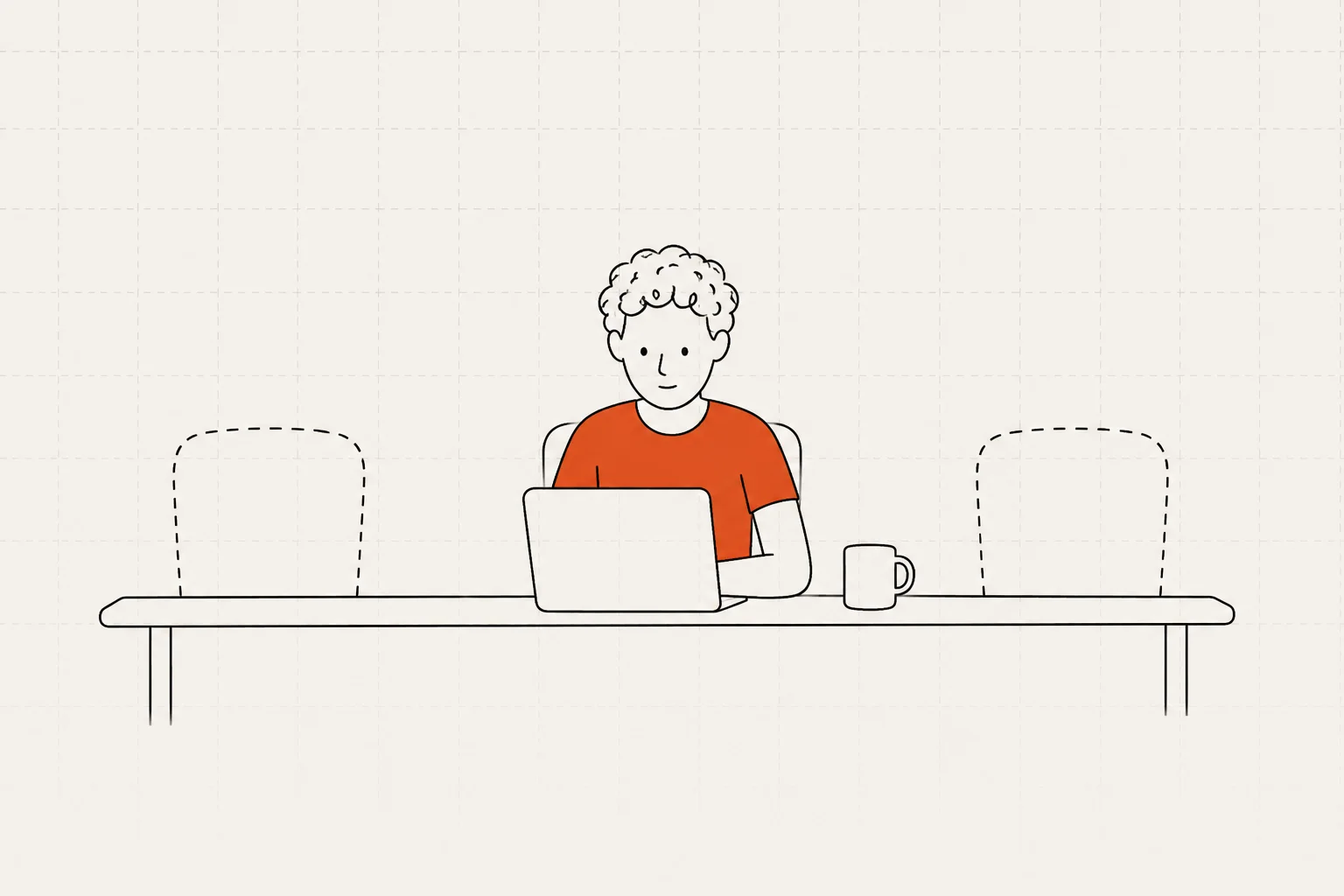
I did three projects with the same two people, childhood friends: 21BJ, then Sp3llbound Studios and Bitzuma. Two we shut down, one we sold.
Since October 2025 I build alone. Startupage first, then Calally five months later, both still running.
It wasn't a falling out and it isn't an ideological position. It's a practical choice, made at a time when I didn't have much appetite for making choices, and it holds for now.
The month and a half when I didn't know what to do
Bitzuma sold, the three of us going separate ways, and me briefly outside the tech world with no idea what came next.
It was one or two months with my mood on the floor and some depression in there. I write it down because it happened and because leaving it out would make everything else read as fake, but I'll also put it in proportion: there is far worse in life. It was a bad stretch of work, not a tragedy.
Two things unblocked it, and they arrived together. The first was that AI for the general public was becoming genuinely interesting. The second was discovering the solopreneur world, American and European, people building entire projects on their own.
One video stuck with me, by Marc Lou, the Frenchman behind ShipFast, where he talked about a failure of his own and the dark stretch that followed. My reaction, word for word, was: so I'm not the only one in situations like this.
Not a great intellectual contribution, I know. But when you're convinced you're the only one who got it wrong that way, watching someone say it out loud moves more than ten pieces of advice.
The cofounder paradox
The question I get most often is why I don't find a new co-founder. The answer is the most uncomfortable thing I have to say on the subject.
With my two co-founders I had total trust. Not the LinkedIn phrase: I could have left a million in their account and walked away, without thinking twice. I knew exactly how they reasoned and they knew how I reasoned, because we'd known each other since we were kids.
With someone new that isn't there. And building it takes years that, while you're building a product, you don't have.
So the paradox is this: the best thing I had in my cofounders is exactly what makes them impossible to replace. It isn't that I don't want partners. It's that I've already had the best version, and I know how rare it is.
There's a more mechanical piece too. On 21BJ we were three, and it worked better than two would have, because an odd number unblocks decisions: when we disagreed the majority decided, instead of sitting at fifty fifty. The saying is that the best team is an odd number of founders, and three is too many. It's funny because the implied conclusion is one, which is exactly where I ended up.
What lets me do it now and not three years ago
AI, though not for the reason everyone gives.
The standard story is "I write code faster". True, and the least interesting part. The constraint that killed me on 21BJ was never the code: it was the team. Twenty people to coordinate, hundreds of calls, the admin, and a technical cofounder we didn't have and kept looking for while time passed.
In the pre AI era a technical founder was mandatory. That equation has changed, and not only on the code: AI as a working partner on marketing, on user acquisition and on automation is what lets me do a startup again without doing the team again. I wrote about it at length in AI makes you build faster, not decide better, because there's a flip side too.
What I lost, without sugar coating it
Three things, and they're real.
The pushback. When there were three of us, a bad idea got taken apart in half an hour. Now it can survive for weeks, because nobody challenges it. My countermeasures are publishing the process as it happens and putting an expiry date on every bet, but they're substitutes and I know it.
A ceiling on what I can build. Alone I would never again do a 3D game on Unreal Engine. That has pushed me towards simpler products, which is sometimes good and sometimes a limit. Selling the limit as a superpower would be dishonest.
Speed in the phases where the direction is already clear. When you know what to build, three pairs of hands beat one pair, every time. The advantage of working alone sits entirely in the phase where you don't yet know what to build.
On rounds, which is a different question
Working alone and taking no money get conflated constantly. They aren't the same choice and they don't have the same reasons.
On rounds my position is less absolute than it looks. Raising is a full time job: I did it for two years across London, Paris and half of Europe, and it produced nothing. I'd rather be on the product and the first users.
But I have nothing against VCs. With an investor you grow faster, and I have no problem saying so. If you're aiming for a startup that grows extremely fast, it isn't even an option: it's mandatory.
The point is that bringing in a VC means having people inside the company who decide alongside you. You answer to them, and depending on how big their stake is they can put decisions on you. I want to run my own things with complete autonomy, without answering to anyone, and that is the whole reason I'm not looking for them.
At least for this phase.
How I work now
Few rules, and all of them come from mistakes I paid for.
- I look for people who already have the problem. If I can't find them, I don't start.
- Every bet gets an expiry date, set at the beginning.
- I watch who comes back the following week, not who signs up.
- I keep a financial floor under my feet.
- No calls and no consulting.
The fourth one cost me the most. On 21BJ we went all in, our own money ran out, and when it runs out you start making worse decisions. Today I'd tell anyone to start as a side project.
The last one sounds like a pose and is actually the most concrete lesson I have. I did between three and four hundred calls to build a team I then had to send home, and my co-founders and I used to compete over who could dodge more of them.
You can see the result on the projects page: two live products, one exit, two shutdowns. All with the same space.
Frequently asked questions
Would you recommend working alone to everyone?
No. It works if your bottleneck is the number of decisions to align. If your bottleneck is a skill you don't have, a co-founder is the right answer and working alone only slows you down.
Why don't you look for a new cofounder?
Because with my two co-founders I had trust built over twenty years of friendship, and that kind of trust isn't found at a networking event. It isn't that I don't want partners: it's that I know how rare what I had is, and recreating it in a hurry with someone new looks like the fastest way to ruin both the project and the relationship.
Would you go back to working in a team?
Yes, I'd like to at some point. Right now I've dug in on doing it alone, and there's a challenge behind that too: seeing how far you get while staying one person. But it's the choice for now, not an identity.
What lets you do all of this on your own?
A small stack I repeat a lot, plus AI for the mechanical parts. I write about it in my stack for shipping a product.
Guglielmo Vaccaro
Startup founder and solopreneur. I build products from zero, alone and with no investors. I share the process as it happens, mistakes included.
About me


